You trust your RO purifier with your family’s health every single day.
But here is a question nobody asks: what happens when your RO membrane degrades, your filter clogs, or your UV bulb burns out?
Nothing. Absolutely nothing. Your RO stays silent. And your family keeps drinking.
The Silent Failure Nobody Talks About
India has approximately 30 million RO purifiers installed in homes. They are the most trusted water safety solution in urban India. Families spend ₹20,000–30,000 on a purifier and assume they are protected.
But here is what the RO industry does not tell you:
| ZERO RO purifiers on the market that actively warn you when filtration has failed |
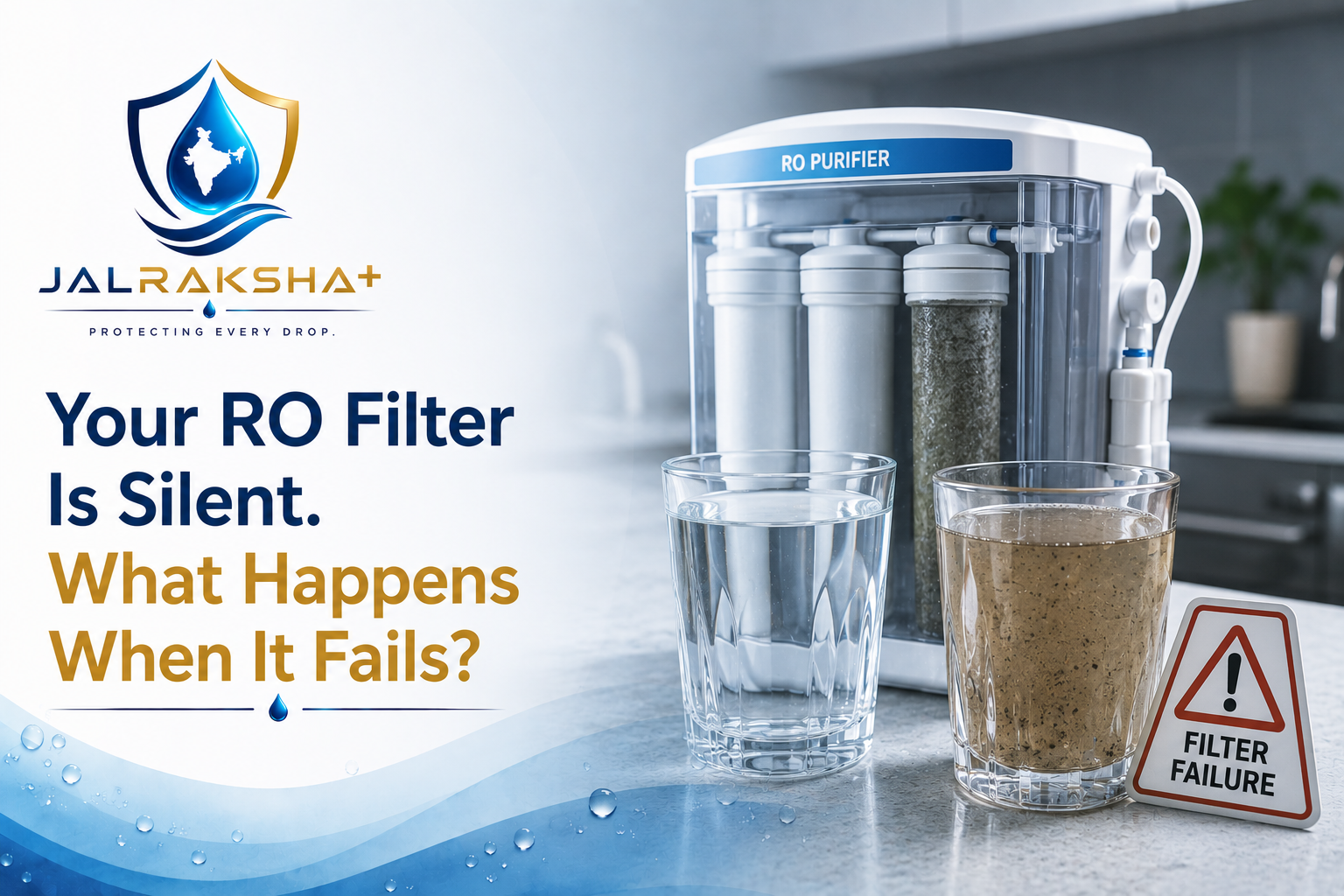
RO membranes degrade gradually. Carbon filters lose effectiveness. UV bulbs dim over months. And when they fail, the water passing through looks exactly the same — clear, tasteless, and seemingly safe.
Your RO does not have a “failure alarm.” It does not turn red. It does not speak. It simply stops protecting you — silently.
Why Families Trust Their RO Blindly
The psychology is understandable:
• The RO was expensive, so it must be working
• The water tastes the same, so nothing has changed
• The service technician came 6 months ago, so everything is fine
• There is no warning light, so there is no problem
This is exactly how invisible risk works. The absence of a warning is not the same as the presence of safety. Your smoke alarm does not beep when there is no fire — but if the battery dies, the alarm is useless.
Your RO is the same. When it works, it is invisible. When it fails, it is also invisible.
How RO Purifiers Actually Fail
Membrane Degradation
The RO membrane is the core of the system. It blocks contaminants at the molecular level. Over time, the membrane develops micro-tears and loses rejection capacity. Contaminants that were once blocked now pass through freely. This degradation is gradual and completely invisible.
Carbon Filter Exhaustion
Activated carbon filters remove chlorine, pesticides, and organic compounds. Once saturated, they stop absorbing — but the water still flows through looking perfectly normal.
UV Bulb Dimming
UV purification kills bacteria by exposing them to ultraviolet light. UV bulbs lose intensity over time. A dim UV bulb provides partial or zero disinfection — but the water looks identical.
Inlet Contamination
If your inlet water quality changes dramatically — due to a tanker delivery, monsoon flooding, or supply line break — your RO may be overwhelmed. The system was calibrated for one source. A sudden change can exceed its filtration capacity.
| DID YOU KNOW? Most RO service contracts recommend filter changes every 6–12 months. But degradation starts much earlier. Between service visits, you have zero visibility into whether your purifier is actually working. |
The Family That Trusted Their ₹24,000 Purifier
A family in Gurugram installed a premium RO purifier — one of the most reputable brands in India. They followed the service schedule. They changed filters on time. They trusted the system completely.
Then, during a summer heat wave, their municipal supply was supplemented with tanker water. The tanker source had significantly higher TDS and bacterial load than their usual supply.
The RO struggled silently. The membrane, already 8 months old, could not handle the sudden increase in contamination. The family drank this partially purified water for 10 days.
The result: the father and both children developed gastrointestinal infections. The doctor confirmed bacterial contamination as the cause.
| If a monitoring device had been installed alongside the RO, it would have detected the sudden change in water chemistry within seconds. The alert would have been immediate: ORANGE — boil water before drinking. Ten days of exposure. Three family members ill. All preventable with real-time awareness. |
RO Purifiers Clean Water. But They Cannot Guard It.
This is the critical distinction:
| MYTH | REALITY |
| RO purifier = complete water safety | RO purifier = water cleaning. Safety requires monitoring + cleaning together. |
| If the RO is running, the water is safe | A running RO with a degraded membrane is worse than no RO — because it creates false confidence |
| Service visits ensure safety | Service visits are snapshots. Between visits, you have no protection against failure |
What is missing is not better filtration. What is missing is a safety layer — something that watches the water continuously, detects when quality drops, and alerts you before you drink.
Think of it this way: a car has brakes (RO). But it also has a dashboard with warning lights (monitoring). You would never drive a car with no dashboard. Why would you drink water with no monitoring?
The Complete Water Safety System
The future of water safety is not choosing between filtration and monitoring. It is combining both.
An RO purifier that cleans your water, paired with a real-time monitoring device that watches it continuously — alerting you instantly if the RO fails, the source changes, or contamination is detected.
Cleaning + Guarding = Complete Protection.
This is the concept behind what industry experts are beginning to call the “Complete Water Safety System” — and it is the direction every Indian home should be moving towards.
What You Should Do Right Now
• Do not assume your RO is working just because water is flowing through it
• Schedule filter changes proactively — do not wait for service reminders
• Be especially vigilant during monsoon, supply changes, and tanker deliveries
• Ask yourself: if my RO fails right now, how would I know?
• Consider adding a monitoring layer alongside your purifier for continuous safety awareness
| YOUR RO CLEANS. BUT WHO GUARDS? Learn how real-time monitoring works alongside your existing purifier. Protect your family with awareness — not just filtration. Visit jalrakshaplus.com |