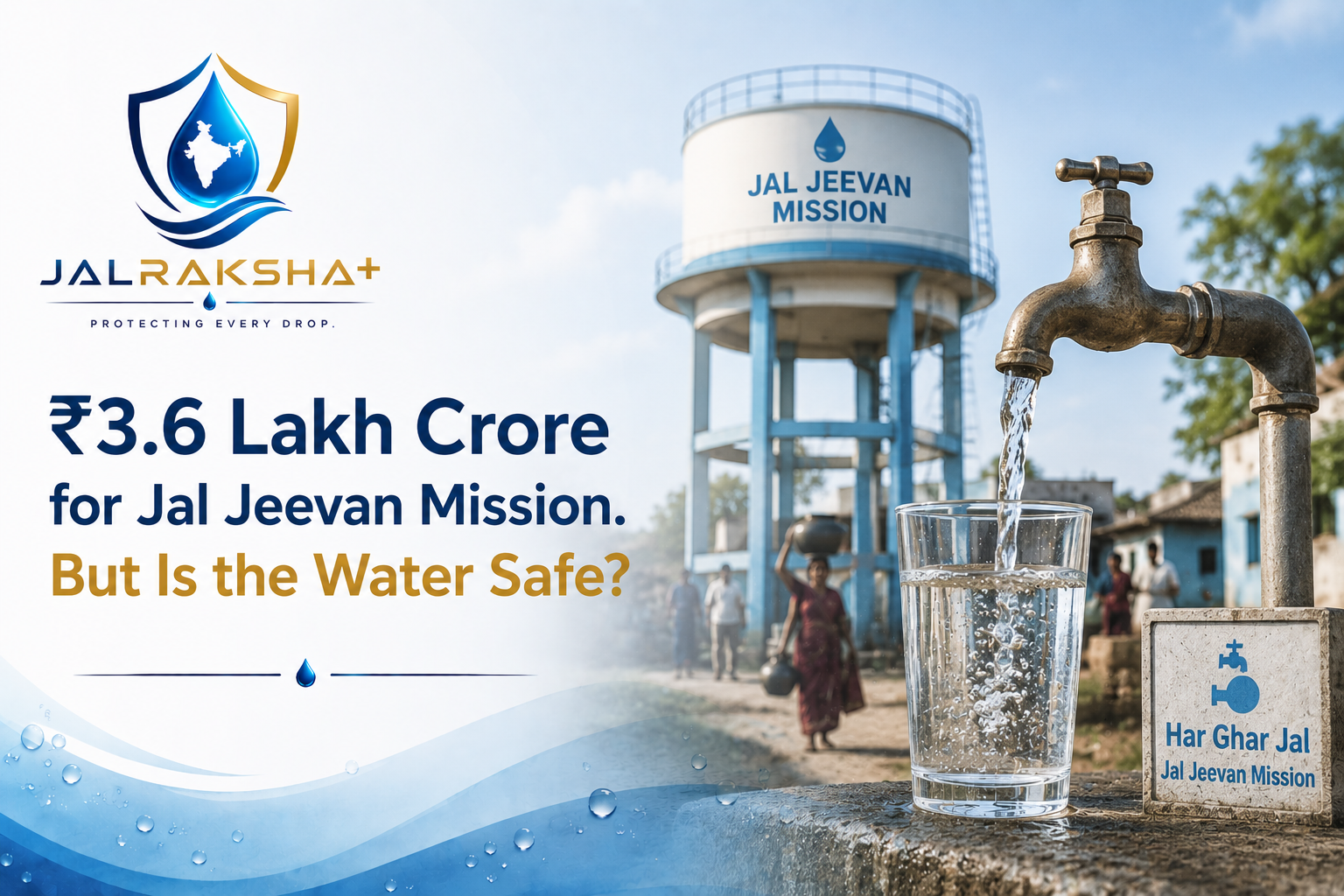
India is spending ₹3.6 lakh crore to deliver tap water to every rural household.
Pipelines are being built. Connections are being made. Numbers are being reported.
But here is the question nobody is asking: once the water reaches the tap, how does anyone know it is actually safe to drink?
The Last-Mile Gap in India’s Water Infrastructure
The Jal Jeevan Mission is one of the most ambitious water infrastructure projects in human history. Its goal is extraordinary: “Har Ghar Jal” — water to every home.
But infrastructure delivery and water safety are not the same thing.
| 600 Million+ Indians live under water stress — even in areas with pipe connections |
Water may leave the treatment plant safe. But between the plant and the glass, it passes through:
• Kilometres of ageing, corroded pipelines
• Overhead and underground storage tanks that may not be cleaned for months
• Mixed sources — municipal, borewell, and tanker — blended without testing
• Seasonal contamination from monsoon flooding and groundwater shifts
| THE MISSING LAYER: India tests water at the source and at the treatment plant. But almost nobody tests it at the point of use — the actual tap where families drink. This is the gap that makes infrastructure delivery alone insufficient for public health outcomes. |
Why Point-of-Use Monitoring Does Not Exist at Scale
The reasons are systemic, not intentional:
1. Lab Testing Is Expensive: Sending samples to accredited labs costs money and time. For 19 crore rural households, the logistics are impossible at continuous scale.
2. Testing Is Periodic, Not Continuous: Even where testing happens, it provides a snapshot — not ongoing safety. Water quality can change within hours due to supply interruptions, flooding, or source changes.
3. No Affordable Device Existed: Until recently, there was simply no technology available that could provide continuous, real-time water quality monitoring at a price point accessible to rural and semi-urban India.
4. Awareness Infrastructure Was Never Planned: Water missions focused on delivery infrastructure — pipes, pumps, and treatment plants. The concept of awareness infrastructure at the household level was not part of the original design.
What “Point-of-Use Verification” Actually Means
Point-of-use verification is a simple concept: test the water where people actually drink it. Not at the treatment plant. Not at the pipeline junction. At the kitchen tap. At the school water cooler. At the village handpump.
This matters because contamination can enter the supply chain at any point after treatment. Old pipes. Damaged tanks. Cross-connections with drainage lines. Seasonal groundwater seepage.
| DID YOU KNOW? Studies have shown that water quality at the treatment plant can differ significantly from water quality at the household tap — sometimes by orders of magnitude in bacterial load. The infrastructure between plant and tap is where safety is most often lost. |
How Real-Time Monitoring Complements India’s National Missions
Jal Jeevan Mission (₹3.6 Lakh Crore)
The mission delivers water connections. Real-time monitoring verifies that the delivered water is actually safe. Together, they complete the promise of “Har Ghar Jal” — not just water to every home, but safe water to every home.
Swachh Bharat Mission 2.0 (₹1.4 Lakh Crore)
Sanitation and safe water are inseparable. Waterborne disease undermines years of public health gains from improved sanitation. Point-of-use monitoring closes this loop.
National Health Mission (₹37,000 Crore/year)
Prevention is always cheaper than treatment. Deploying monitoring devices in schools, primary health centres, and anganwadis could prevent a significant portion of the 37.7 million annual waterborne disease cases.
Smart Cities Mission (₹98,000 Crore)
Smart cities monitor traffic, air quality, and energy consumption. Water safety at the building level remains a blind spot. Real-time water monitoring is the logical next addition to urban infrastructure intelligence.
PM POSHAN / Mid-Day Meal Programme
India’s largest school nutrition programme serves millions of children daily. Safe drinking water is fundamental to the nutrition promise. One monitoring device per school kitchen can provide continuous compliance documentation.
What a Pilot Deployment Could Look Like
Imagine a pilot programme in three gram panchayats across three different states:
| PILOT DESIGN: 3 gram panchayats × 3 states = 9 deployment sites Each site: 1 community-grade monitoring device on the village tank or borewell outlet Solar-powered. GSM-enabled. Sends auto-SMS to Sarpanch and District Water Officer. Cost per device: approximately ₹30,000. Coverage: 500–1,000 people per device. Effective cost: ₹25–60 per person protected. OUTCOME: Real-time data on water quality across 9 communities. Impact evidence for ministry-level review. Foundation for state-level procurement. |
From Infrastructure Delivery to Infrastructure Assurance
India’s water missions have achieved something remarkable: building the physical infrastructure to deliver water at national scale. The next step is equally important: building the awareness infrastructure to verify that the delivered water is safe.
This is not a criticism of existing programmes. It is a recognition that the job is only half done. Delivery without verification is infrastructure without assurance.
Real-time point-of-use monitoring is the missing piece. It is affordable, scalable, and aligned with every major national water and health mission.
Key Takeaways
• Water delivery and water safety are not the same — both are needed
• Point-of-use verification is the missing layer in India’s water infrastructure
• Continuous monitoring is far more effective than periodic testing
• Government pilot programmes can generate evidence for national-scale deployment
• Real-time monitoring complements existing missions — it does not compete with them
| THE INFRASTRUCTURE IS BUILT. THE WATER IS FLOWING. NOW IT’S TIME TO VERIFY. Explore how real-time water monitoring can complete India’s water safety mission. Visit jalrakshaplus.com |