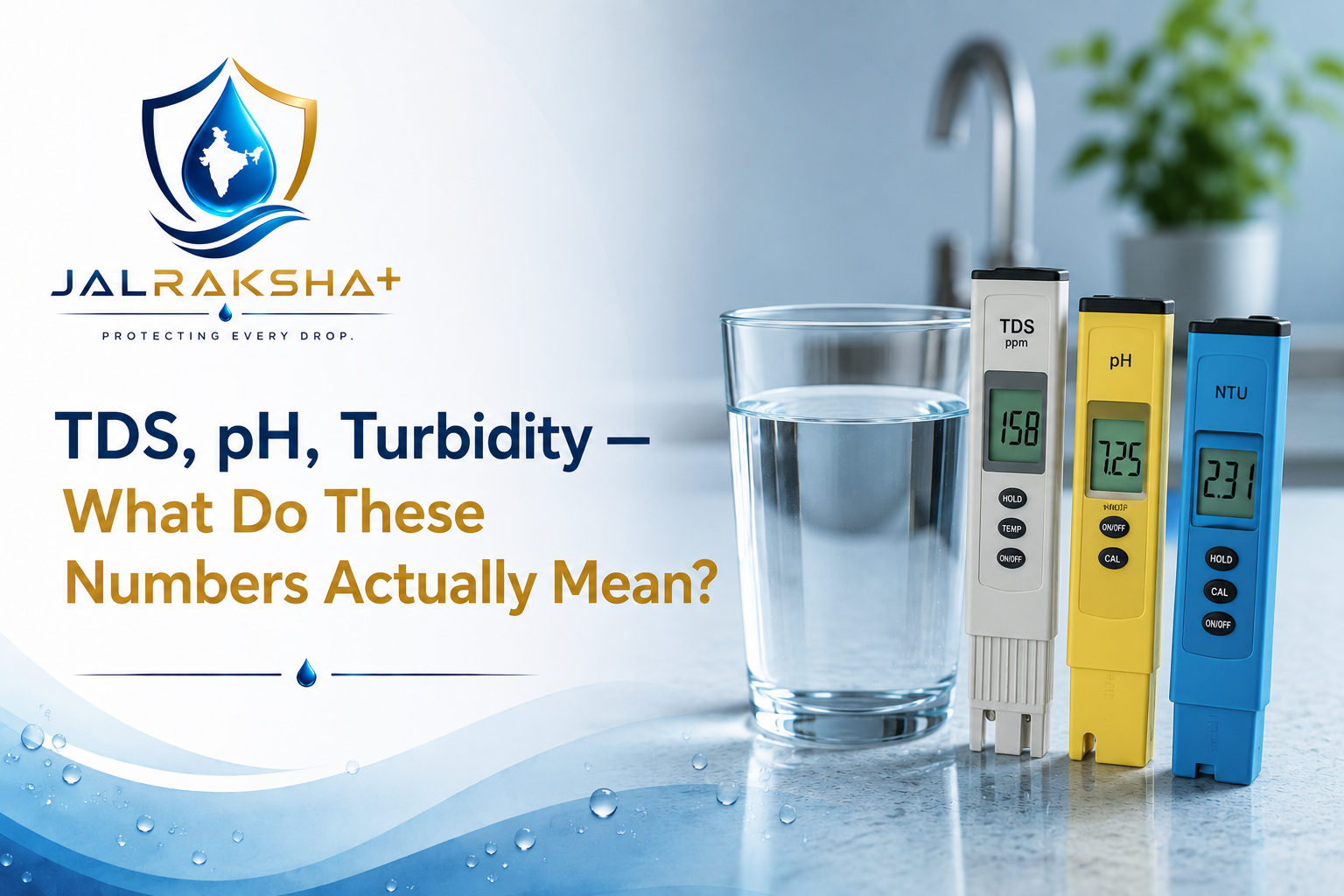
Your RO display says “TDS: 45.” Your water testing report shows “pH: 7.8.”
But do you actually know what these numbers mean? Do you know when they become dangerous?
Most Indian families see water quality numbers but have no idea how to interpret them. This blog will change that — in simple language that anyone can understand.
India’s Families Are Flying Blind
Here is a troubling reality: India generates more water quality data than almost any country in the world. Government labs test. Private labs test. RO displays show TDS numbers daily.
Yet 70% of rural households have never had their water tested. And among urban households that do see numbers, the vast majority have no understanding of what those numbers mean for their health.
| Data without understanding is just noise. A TDS reading of 320 means nothing if you do not know whether 320 is safe, risky, or dangerous. |
Why Numbers Without Context Are Dangerous
Imagine a doctor telling you: “Your blood pressure is 150.” And then walking away. No explanation. No context. No guidance.
That is exactly what a TDS meter does. It gives you a raw number. It does not tell you whether that number is safe. It does not tell you what to do. And it measures only one parameter out of dozens that determine whether your water is truly safe.
The gap is not data. The gap is interpretation and action.
Water Quality Explained — As Simply As Possible
1. TDS (Total Dissolved Solids)
What it is: Everything dissolved in your water — calcium, magnesium, sodium, lead, arsenic, pesticides, and more.
How it is measured: In parts per million (ppm). Think of it as counting how many tiny particles are floating in every million drops of water.
| BIS 10500 SAFE LIMITS: Below 300 ppm — Excellent 300–500 ppm — Acceptable 500–900 ppm — Poor (health risk with prolonged use) Above 900 ppm — Unsafe (do not drink) |
| DID YOU KNOW? Low TDS does not guarantee safety. Water can have a TDS of 50 and still contain dangerous bacteria. TDS measures dissolved solids — not biological contamination. |
2. pH Level
What it is: A measure of how acidic or alkaline your water is, on a scale from 0 (most acidic) to 14 (most alkaline).
Safe range: 6.5 to 8.5 (as per BIS 10500).
Why it matters: A sudden change in pH often signals contamination. If your water was pH 7.2 yesterday and is pH 5.8 today, something has changed in your supply — and it may be dangerous.
| MYTH | REALITY |
| Alkaline water (high pH) is always healthier | Excessively alkaline water can cause skin irritation and digestive issues |
| Slightly acidic water is always dangerous | Mild acidity (pH 6.5–7.0) is perfectly safe; it is sudden changes that signal risk |
3. Turbidity (Water Clarity)
What it is: How cloudy or clear your water is. Measured in NTU (Nephelometric Turbidity Units).
Safe limit: Below 1 NTU for drinking water (BIS 10500).
Why it matters: Cloudy water often contains suspended particles — sediment, rust particles, or organic matter. These particles can harbour bacteria and make disinfection less effective.
| IMPORTANT: Clear water (low turbidity) does not mean safe water. Many of the most dangerous contaminants — arsenic, fluoride, lead, E. coli — are completely invisible. Low turbidity simply means there are no visible particles. It says nothing about dissolved chemicals or bacteria. |
4. Conductivity
What it is: A measure of how well water conducts electricity. More dissolved minerals and salts = higher conductivity.
Why it matters: Conductivity is closely related to TDS. A sudden spike in conductivity can indicate a new source of contamination entering your water supply.
5. Bacterial Risk
What it is: The presence of harmful microorganisms — E. coli, coliform bacteria, and others.
Why it is the most dangerous: Because it is completely invisible, causes illness within hours, and is especially lethal for children and the elderly.
How it is detected: Traditional methods require lab testing that takes 24–48 hours. Advanced systems can estimate bacterial risk in real-time by cross-referencing turbidity, conductivity, and pH patterns.
The School That Learned the Hard Way
A school in Maharashtra served water from a borewell that had always tested fine during annual inspections. After monsoon flooding in July, the borewell water became contaminated with surface runoff carrying coliform bacteria.
The water looked clear. The TDS was normal. But 150 students fell ill with severe diarrhoea within one week.
The problem was not the water’s appearance — it was the bacterial contamination that no visual check could catch. And annual testing had missed the seasonal change entirely.
| DID YOU KNOW? Monsoon season is the highest-risk period for waterborne disease in India. Flooding introduces surface bacteria into borewells and municipal systems. Yet most water testing happens only once or twice a year. |
Why Knowing the Numbers Is Not Enough
Even if you understand TDS, pH, and turbidity perfectly, there is still a fundamental gap:
• A single test gives you a snapshot — not continuous protection
• Water quality changes hourly, especially with tanker deliveries and seasonal shifts
• No family can test their water every time they pour a glass
What families need is not more numbers. They need continuous, real-time interpretation — a system that watches the water 24/7 and translates complex data into one simple signal: safe, or not safe.
The Future of Water Safety Is Real-Time Interpretation
Imagine if every water quality measurement happened automatically, continuously, and silently — and the result was delivered not as a confusing number, but as a clear colour and a spoken voice alert.
Green: safe to drink. Orange: boil first. Red: stop immediately. Purple: your source has changed.
No charts. No spreadsheets. No lab waiting periods. Just instant, continuous clarity.
This is the direction water safety technology is heading — and it is exactly the kind of awareness that every Indian home, school, and village deserves.
Key Takeaways for Every Family
• TDS below 500 ppm is acceptable, but low TDS does not mean safe — bacteria are invisible to TDS meters
• pH should stay between 6.5 and 8.5 — sudden shifts are a warning sign
• Clear water can still be contaminated — never rely on appearance alone
• Annual lab tests miss seasonal changes — continuous monitoring is essential
• Understand the difference: RO cleans water, but nothing tells you when the RO has failed
| STOP GUESSING. START UNDERSTANDING. Learn how real-time water monitoring turns complex data into simple, life-saving clarity. Your family’s health is too important to leave to guesswork. Visit jalrakshaplus.com |