X

About Us

💧 JalRaksha+ — India's Guardian of Water Safety. Real-time monitoring for every home, school, and village. A Kenoxis Technologies Initiative. Badges: 🇮🇳 Made for India | 🔒 BIS Aligned

Contact Info

  • Mississauga, Ontario, Canada
  • help@jalrakshaplus.com
  • Week Days: 09.00 to 18.00
Advanced Multi-Parameter Sensor System

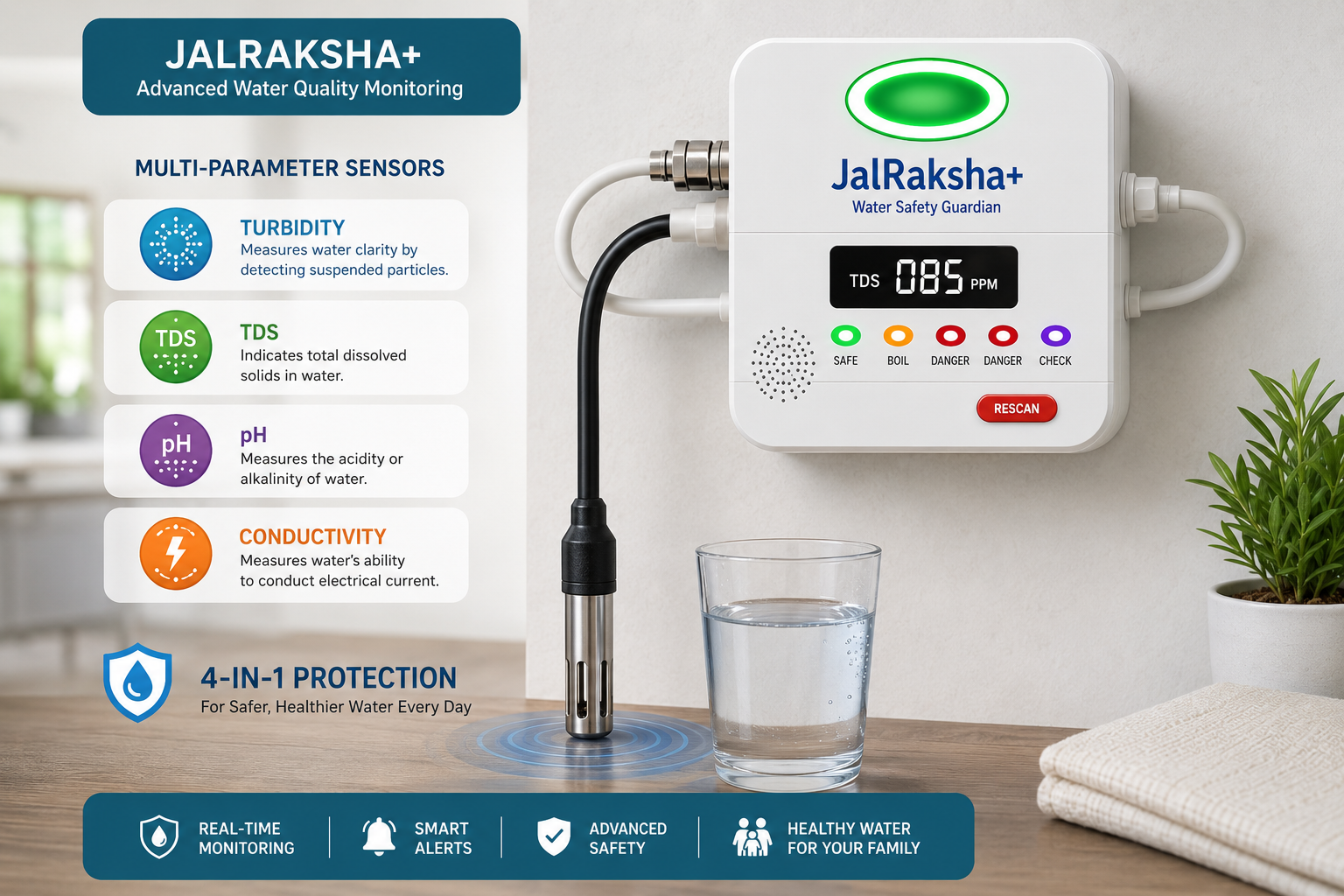
At the heart of JalRaksha+ is a sophisticated multi-parameter sensing array capable of continuously monitoring critical indicators of water quality.

Technology Behind JalRaksha+

Engineering Intelligence for India’s Water Safety Future

JalRaksha+ is more than a water monitoring device — it is a deeply engineered, real-time water intelligence platform built specifically for the environmental, infrastructural, and operational realities of India.

Every JalRaksha+ unit combines advanced sensing technology, edge AI analysis, intuitive alert systems, resilient hardware, and rural-ready connectivity into one unified ecosystem designed to make water safety understandable, actionable, and accessible for everyone.

From dense urban housing societies to remote rural communities, JalRaksha+ has been engineered to deliver continuous protection where traditional systems fail.

  • Monitors water conditions
  • Processes risk patterns instantly
  • Detects abnormal variations
  • Communicates actionable alerts in real time
Sensors — Turbidity, TDS, pH, Conductivity

Advanced Multi-Parameter.
Sensor System.

At the heart of every JalRaksha+ device is a multi-parameter sensor array designed to measure key indicators of water quality simultaneously. The system monitors turbidity, pH, TDS, and conductivity together, creating a broader understanding of water conditions than any single sensor could provide.

This layered sensing approach is important because water safety is not determined by one reading alone. Turbidity can signal suspended particles or contamination. pH can reveal acidity or alkalinity changes that may indicate chemical imbalance. Conductivity and TDS help identify dissolved solids and shifts in mineral or contamination load. When analyzed together, these readings give JalRaksha+ a more complete picture of the water source.

Key Sensor Functions

  • Turbidity sensing to measure water clarity and visible particulate variation
  • pH monitoring to detect shifts in acidity or alkalinity
  • Conductivity measurement to track dissolved ion levels
  • TDS estimation to assess overall dissolved solids concentration
  • Combined analysis for a fuller, more reliable understanding of water safety
AI Risk Engine

Real-Time Analysis Without .
Cloud Dependencer.

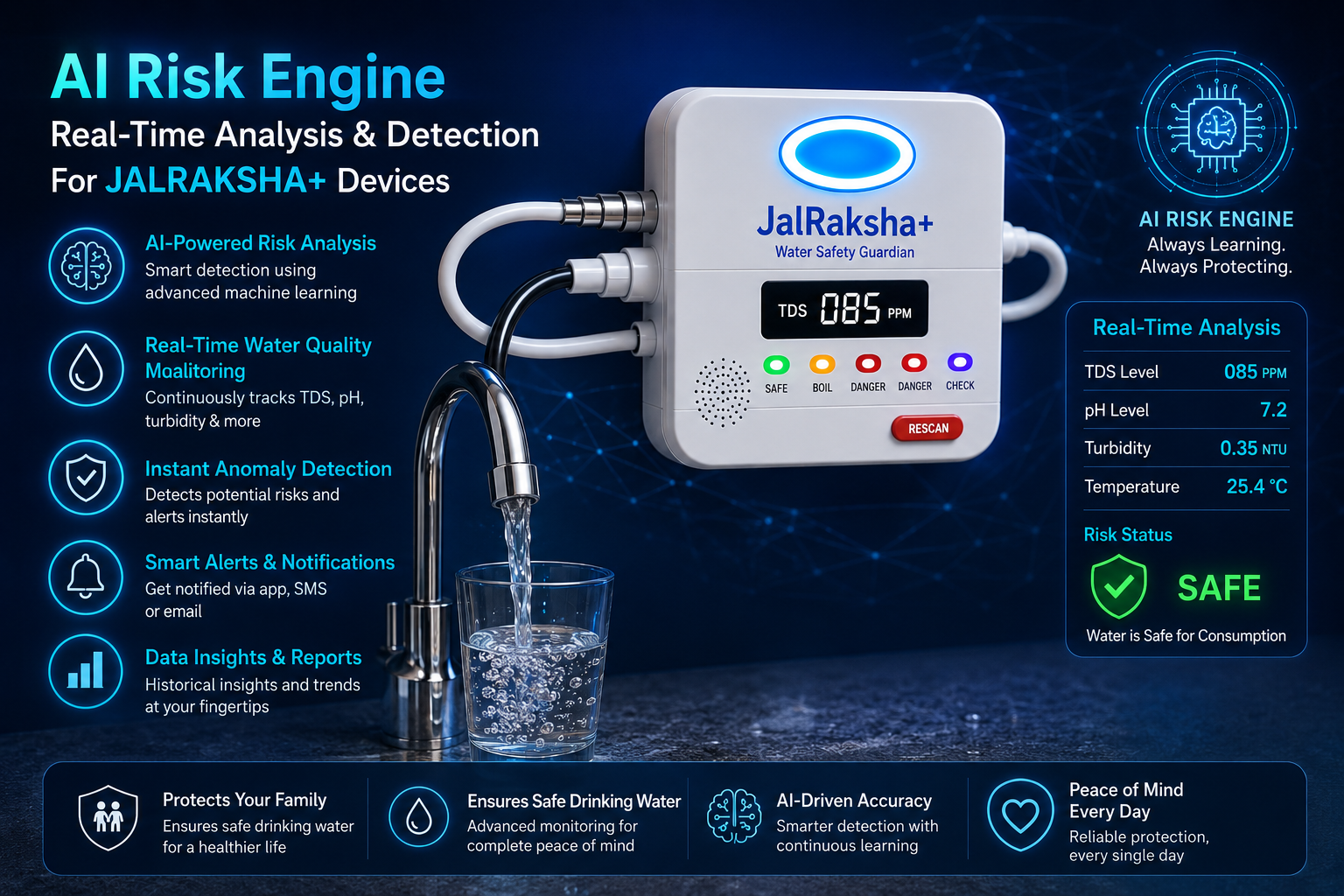
JalRaksha+ uses a proprietary edge-based risk engine that continuously evaluates sensor data in real time. Instead of sending data to the cloud and waiting for a remote response, the device processes information locally at the edge. This makes the system faster, more resilient, and far better suited for environments with weak internet access.

The AI risk engine compares live sensor readings against accepted safety thresholds and decision rules. It is designed to identify meaningful patterns, not just isolated numbers. For example, a sudden rise in turbidity combined with a change in conductivity may indicate a water source shift or a possible contamination event. The system can interpret these patterns and trigger the appropriate alert level.


What the AI Engine Does

  • Cross-references sensor outputs in real time
  • Compares readings against defined water safety limits
  • Detects sudden changes and abnormal patterns
  • Evaluates likely risk states from combined data signals
  • Operates locally without depending on cloud connectivity

Why Edge Processing Matters

  • Faster response times
  • Better reliability in low-network areas
  • Reduced latency during emergencies
  • Greater privacy and operational independence
  • Continued function even when internet access is unavailable
4-Colour Alerts

Instant Visual Understanding .
for Everyone.

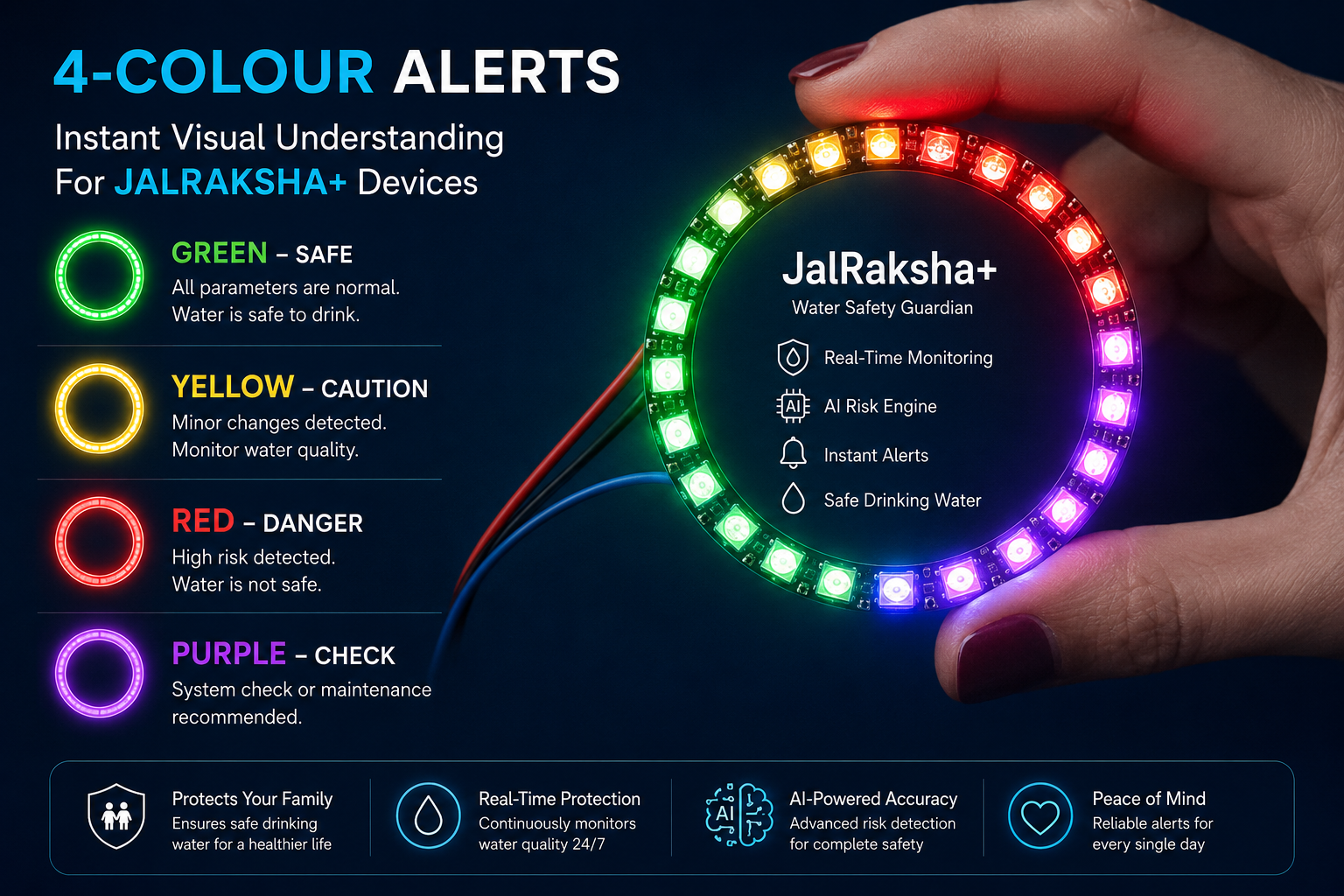
One of the most powerful parts of JalRaksha+ is its four-colour alert system. Instead of forcing users to interpret technical data, the device converts complex readings into simple, universal visual states. This makes the system usable by families, school staff, community workers, and local officials without requiring technical training.

Each colour corresponds to a specific action state. Green means safe water. Orange indicates possible bacterial risk and recommends boiling before use. Red signals chemical danger and immediate stoppage of use. Purple indicates a source change, meaning users should verify where the water is coming from before relying on it.

Colour Logic

  • Green: Safe to use, all key parameters within limits
  • Orange: Possible bacterial risk, boil before drinking
  • Red: Chemical danger, stop use immediately
  • Purple: Source change detected, verify supply origin

Why the Colour System Works

  • Fast recognition in urgent situations
  • Easy for all age groups to understand
  • No technical language required
  • Useful in homes, schools, villages, and public facilities
  • Improves response time when water conditions change
Voice & Audio — Hindi & English Voice Guidance

Human-Centered Communication .
Technology .

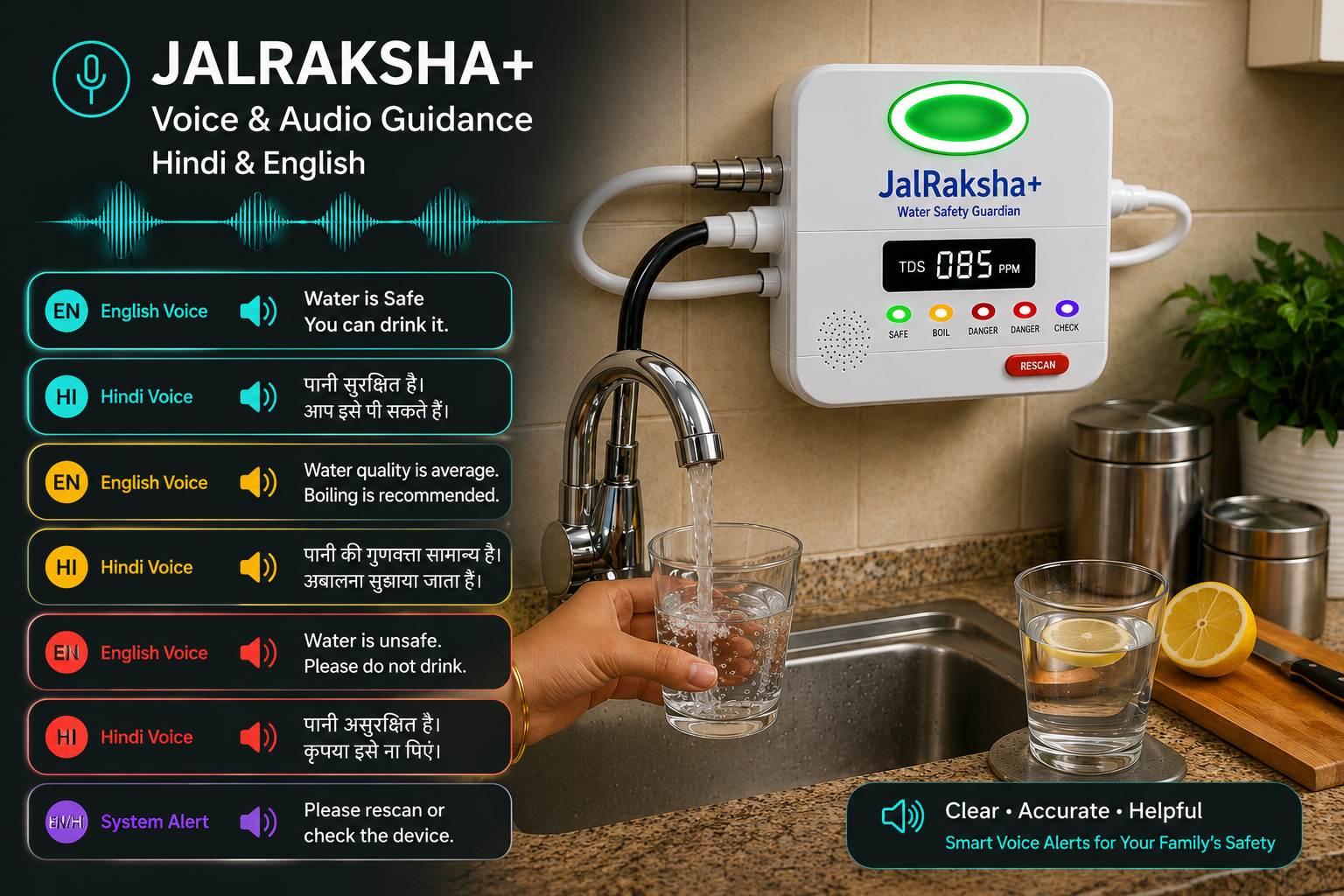
JalRaksha+ is designed for real people in real environments, which is why it includes voice-based communication. When the device detects a risk state, it does not rely only on lights or numbers. It speaks clearly in Hindi and English, guiding users with direct, action-oriented messages.

Each colour state has its own unique audio alert so that users do not just see the warning, they understand exactly what it means. This makes the system much more effective in homes, community spaces, and public institutions where not everyone may be comfortable reading technical displays.

Voice System Features

  • Pre-recorded spoken alerts in Hindi and English
  • Unique message for each alert color
  • Action guidance built into the alert
  • Clear, understandable communication for all users
  • Roadmap support for additional Indian languages

Planned Language Expansion

  • Tamil
  • Telugu
  • Bengali
  • Marathi
  • Punjabi
Connectivity — GSM / SMS (Community Edition)

Built for.
Rural India & Public Infrastructure.

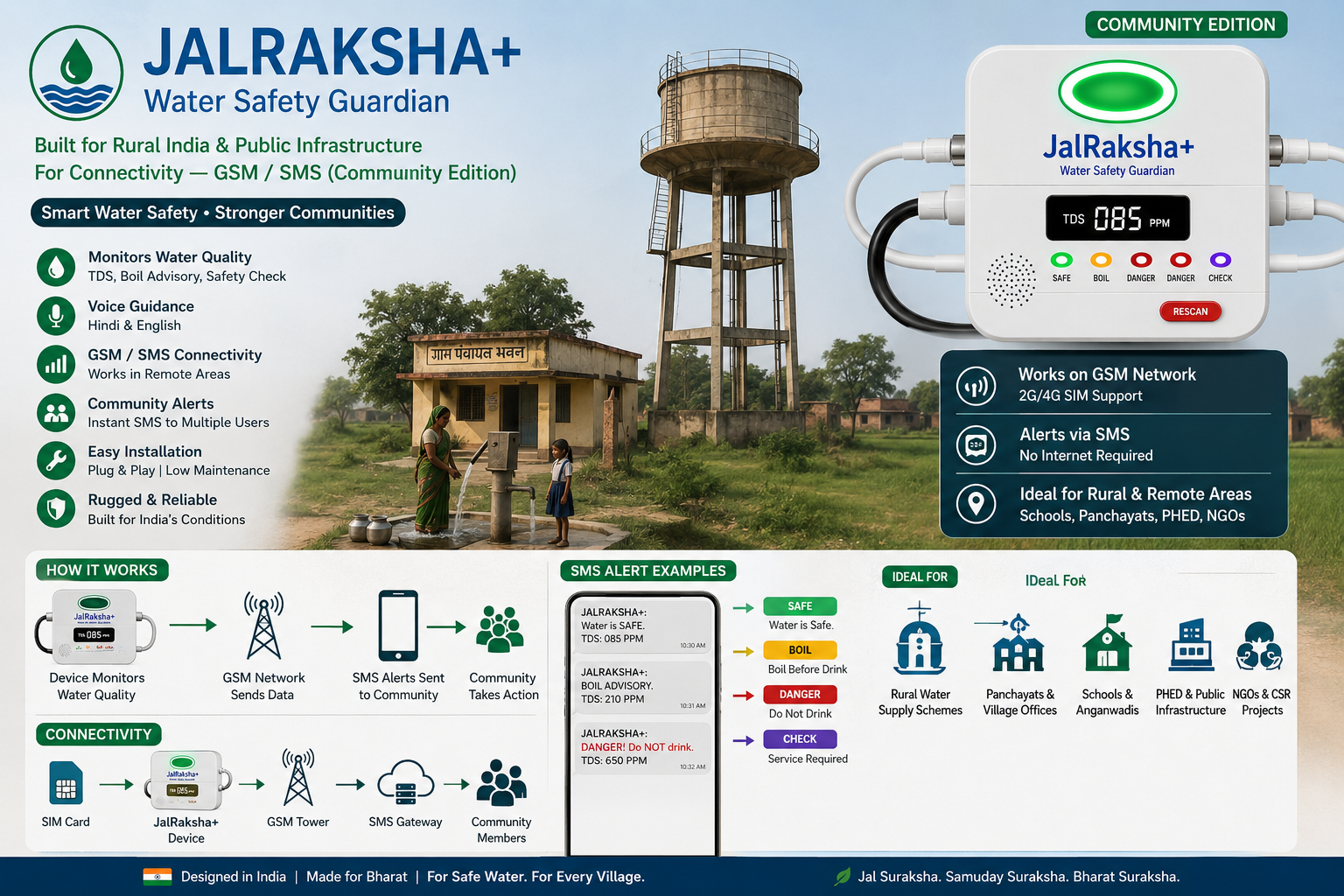
For community deployments, JalRaksha+ includes SIM-based GSM communication support. This allows the device to send automatic SMS alerts to designated officials and stakeholders when an important change is detected. In community environments, this can make the difference between a delayed response and a timely intervention.

The community edition is especially valuable for rural water systems, shared supply points, and public infrastructure where responsible authorities need to be informed quickly. Because the system is designed to work on 2G networks, it can operate in regions where modern broadband is limited but mobile coverage still exists.

Who Can Receive Alerts

  • Sarpanch
  • District Water Officer
  • Health Department officials
  • School administrators
  • Community maintenance teams

Connectivity Benefits

  • Automatic SMS alerts
  • Wide rural compatibility
  • Works on low-bandwidth networks
  • Faster escalation for local decision-makers
  • Useful where app-based systems may fail
Hardware — Rugged, Reliable, Made for India

Built to Withstand Dust, Water,
Heat, & Field Use

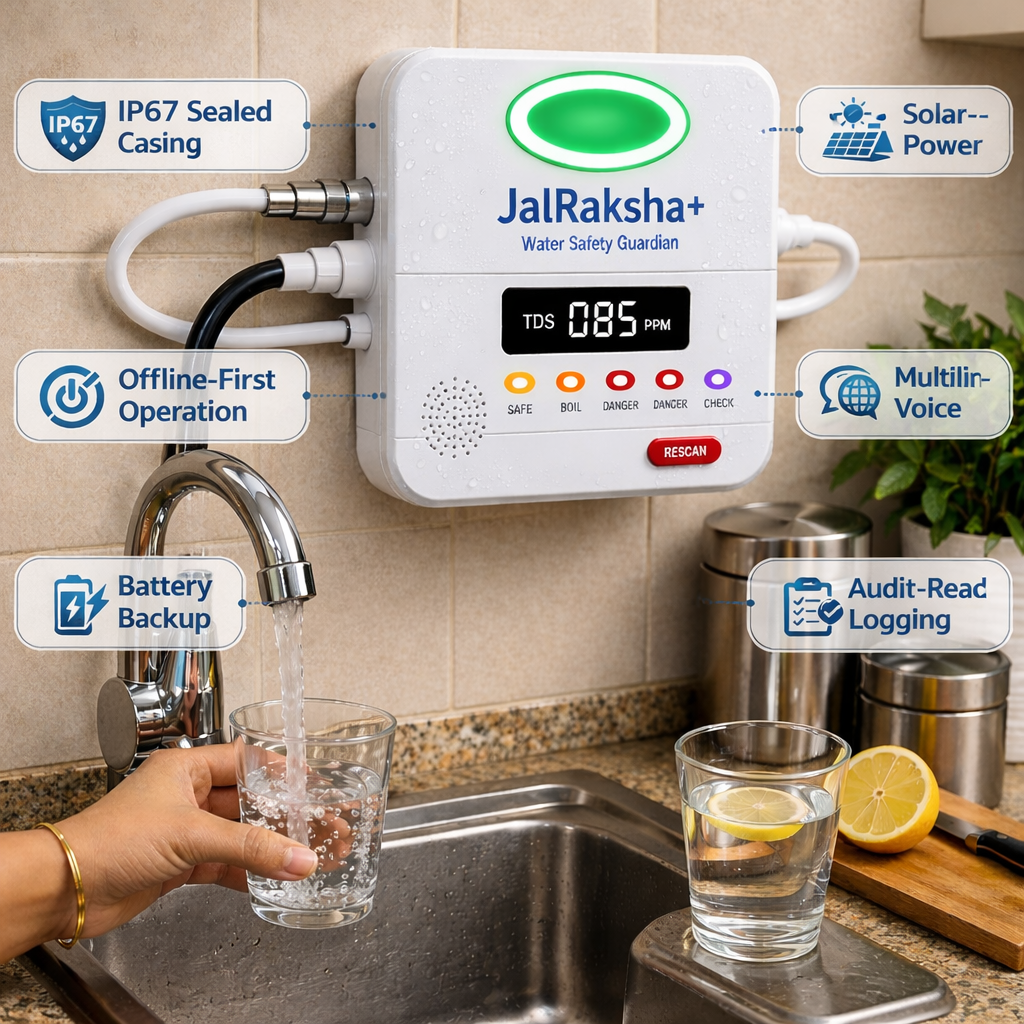
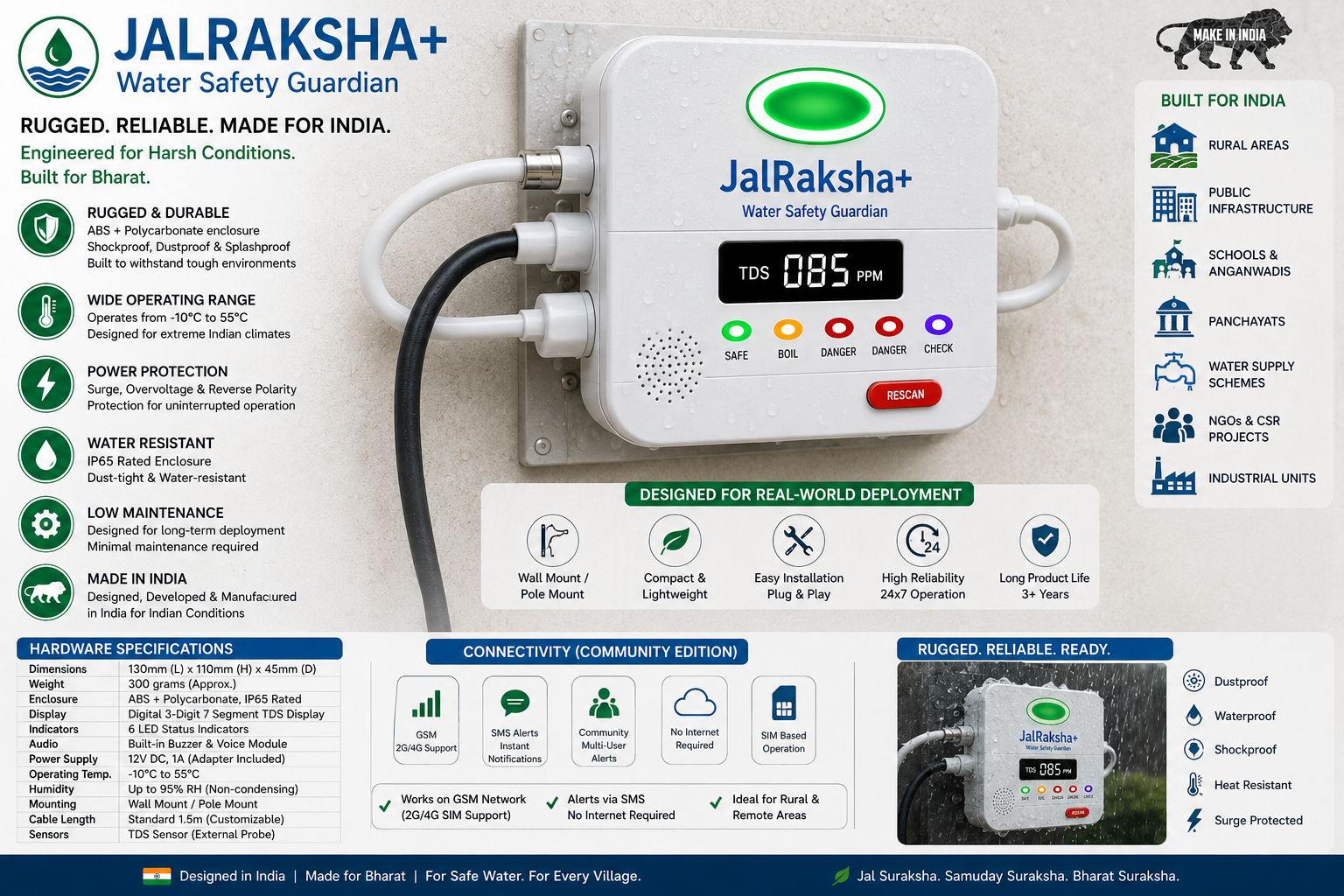
The JalRaksha+ hardware platform is designed with durability at its core. It features an IP67-rated casing to help protect the device from dust and water exposure, making it suitable for demanding environments where ordinary electronics may fail.

The device also includes dual power support through mains and battery backup, so monitoring continues even during outages. For off-grid and sustainability-focused deployments, solar panel input provides an additional power option. Together, these features make JalRaksha+ suitable for urban homes, institutions, and remote rural environments alike.

Hardware Features

  • IP67 dustproof and waterproof enclosure
  • Mains power with battery backup
  • Solar panel input for off-grid use
  • Tamper-resistant mounting
  • Annual calibration protocol
  • On-device data logging for 30–90 days

Why the Hardware Design Matters

  • Reliable operation in harsh environments
  • Lower maintenance burden
  • Better field survivability
  • Stronger protection from accidental or deliberate damage
  • Suitable for both permanent and temporary installations